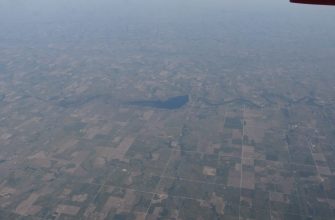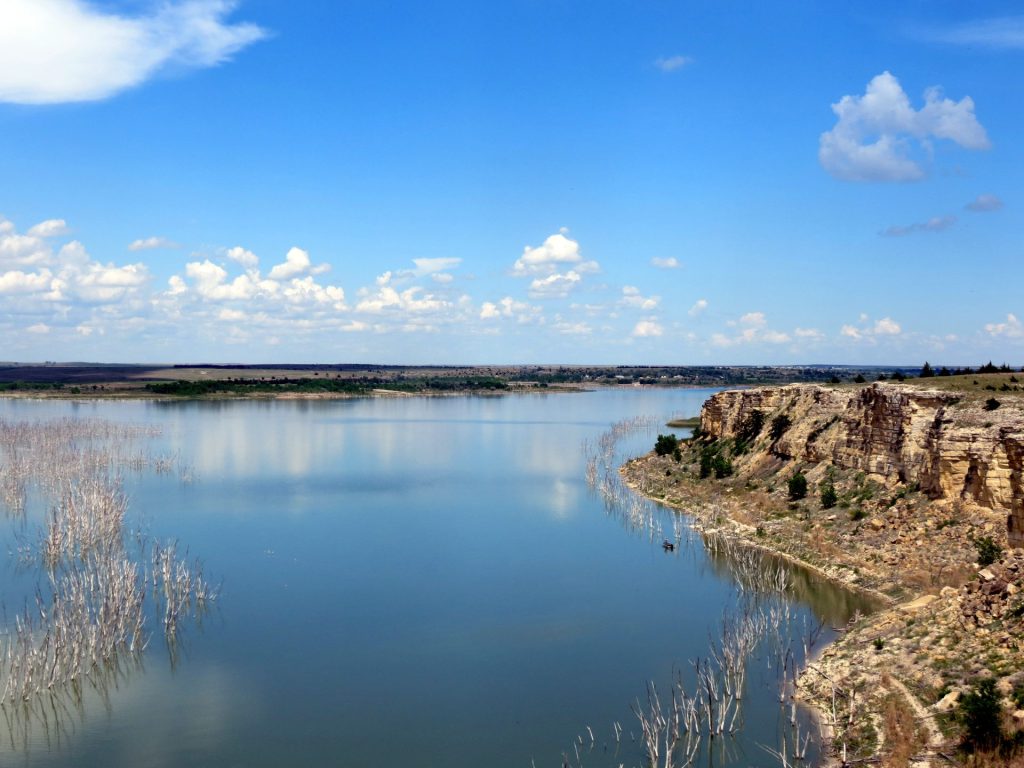
Cedar Bluff is the lake to know if you want clear water, big skies and almost no crowds. Way out in western Kansas, a short drive south of I-70 between Denver and Kansas City, this high-plains reservoir sits beneath 150-foot limestone bluffs – the eroded floor of an ancient sea – in a landscape that feels more like the West than the prairie. It’s an under-the-radar place: a genuinely good walleye and white-bass fishery, two very different state-park areas, cabins and primitive camping, and the kind of quiet, star-filled nights you don’t get at the busy eastern lakes.
This guide covers all of Cedar Bluff – the fishing, the bluffs and the geology, the Bluffton and Page Creek camping areas, and the practical realities of a western reservoir whose water level can swing with the drought. It’s part of our growing Kansas Lakes Database.
- Cedar Bluff Reservoir at a glance
- The lake under the bluffs
- Fishing Cedar Bluff Reservoir
- Is Cedar Bluff safe to swim? Water clarity and algae
- Boating and the beaches
- Camping: Bluffton and Page Creek
- Getting there and what’s nearby
- Know before you go
- Frequently asked questions
- How big is Cedar Bluff Reservoir?
- What fish can you catch at Cedar Bluff?
- What are the bluffs at Cedar Bluff?
- Can you camp at Cedar Bluff?
- Is Cedar Bluff a good lake for swimming?
- Where is Cedar Bluff Reservoir?
Cedar Bluff Reservoir at a glance
- Size: ~6,900 acres at full pool (it can run well below that in dry years); about 50 miles of shoreline
- Maximum depth: about 42 feet; full-pool elevation around 2,144 feet – true high plains
- Location: Trego County, about 13 miles south of I-70 between WaKeeney and Ellis/Hays
- Built: dam on the Smoky Hill River, completed in 1951 by the U.S. Bureau of Reclamation
- Top fish: walleye, white bass, wiper, crappie, smallmouth and largemouth bass, channel catfish
- Famous for: clear water, 150-foot limestone bluffs and quiet, scenic camping
The lake under the bluffs
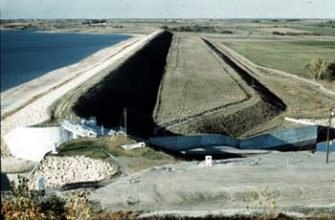
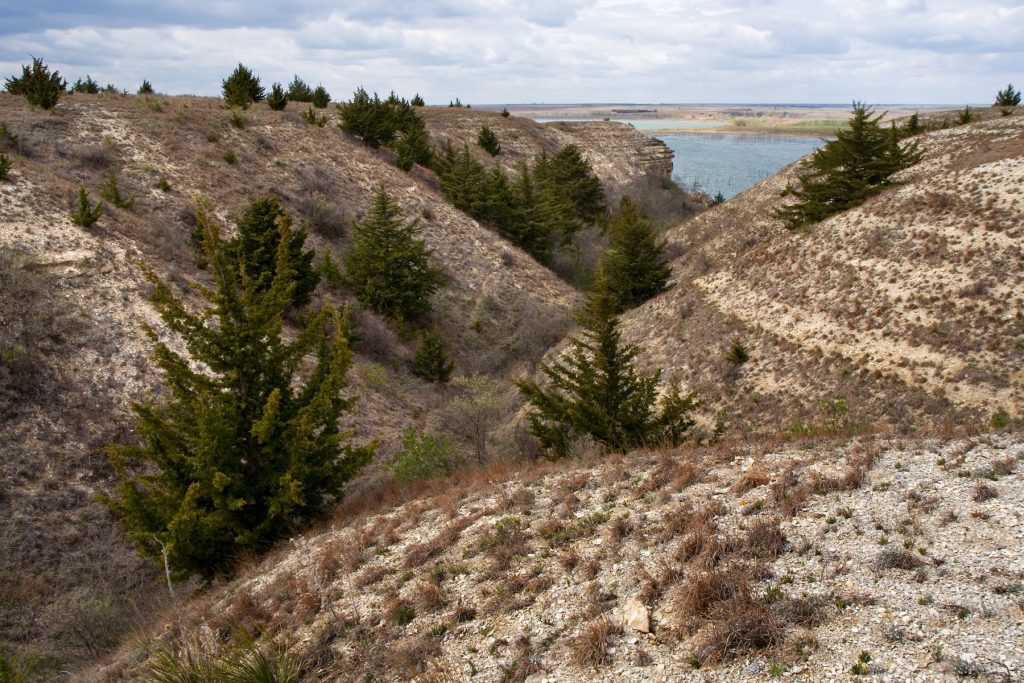
The bluffs give the lake its name and its character. They rise as much as 150 feet above the water – pale limestone laid down when this whole region was the floor of the Western Interior Seaway, then carved by millions of years of wind and water into the cliffs you see today. The Bureau of Reclamation dammed the Smoky Hill River here and finished the reservoir in 1951, originally to irrigate downstream farmland. That irrigation role faded by the late 1970s as the Smoky Hill’s flow dwindled, and Cedar Bluff settled into the recreation-and-fishing lake it is today – clearer and deeper-feeling than the muddy reservoirs back east, and far quieter.
Fishing Cedar Bluff Reservoir
Cedar Bluff’s clearer water makes it a quality fishery, and walleye is the headliner – note the 21-inch minimum length limit and five-fish daily creel, a sign of how the lake is managed for quality. It’s also strong for white bass and wiper (the Bluffton area on the north shore is a known spot), with crappie, smallmouth and largemouth bass, channel catfish and bluegill rounding things out.
- Walleye: fish the points, the dam, the river channel and the rocky breaks at low light; mind the 21-inch limit.
- White bass & wiper: chase surface-feeding schools in open water on summer mornings and evenings.
- Smallmouth bass: the rocky, clearer shorelines suit smallmouth – work the breaks with finesse.
- Crappie & catfish: find crappie on structure and channel cats on the flats and up the river arm.
Anglers 16 to 74 need a Kansas fishing license; check the latest KDWP fishing report and the current limits before you go.
Is Cedar Bluff safe to swim? Water clarity and algae
Cedar Bluff’s clearer, deeper water means it tends to see fewer blue-green algae problems than the shallow eastern reservoirs, and it has popular swim beaches – but no Kansas lake is immune, so check the current KDHE advisory before you swim and avoid any visible scum. The bigger thing to watch out here is the water level: as a western reservoir on a dwindling river, Cedar Bluff can drop a long way in drought, which moves the shoreline and can close ramps. Check current conditions before you trailer a boat.
Boating and the beaches
With four boat ramps split between the two park areas, Cedar Bluff is easy to launch on, and the clear water and open setting make it a pleasant boating, paddling and swimming lake. It rarely feels crowded. Just respect the wind, which can build fast across the open high plains, and keep an eye on the water level so you know which ramps are usable.
Camping: Bluffton and Page Creek
Cedar Bluff State Park is split into two areas with very different personalities:
- Bluffton, on the north shore, is the developed side – about 96 utility campsites, five modern cabins, a group campground, two boat ramps, showerhouses and a swim beach.
- Page Creek, on the south shore, offers some of the finest primitive camping in Kansas – quiet, scenic sites plus 36 utility spots, with the paved, ADA-accessible Agave Ridge Nature Trail winding along the bluffs near Boy Scout Cove.
There’s also an archery range, a BMX track, sand volleyball and playgrounds. Reserve sites and cabins through the Kansas State Parks system, and remember the state-park vehicle permit.
Getting there and what’s nearby
Cedar Bluff sits about 13 miles south of I-70, roughly halfway across the state – an easy break on a Denver-to-Kansas-City drive. Nearby Hays has the Sternberg Museum of Natural History (fitting, given the ancient seabed – it’s famous for its “fish-within-a-fish” fossil and other seaway creatures) and Fort Hays. And the chalk badlands of western Kansas – Castle Rock and Monument Rocks – are a scenic drive away, more of the same ancient-sea geology you see in the bluffs.
Know before you go
- State park permit: a Kansas state-park vehicle permit is required for Cedar Bluff State Park (daily or annual).
- Fishing license: anglers 16-74 need a Kansas fishing license; note the 21-inch walleye limit.
- Water level: as a western reservoir Cedar Bluff can drop sharply in drought – check current conditions and ramp status before launching.
- Algae: usually low risk here, but check the current KDHE advisory before swimming.
- Remote: stock up in WaKeeney or Hays – services at the lake are limited.
Frequently asked questions
How big is Cedar Bluff Reservoir?
About 6,900 acres at full pool with roughly 50 miles of shoreline, in Trego County in western Kansas – though it can run well below full pool in dry years.
What fish can you catch at Cedar Bluff?
Walleye is the headliner (with a 21-inch minimum length limit), along with white bass, wiper, crappie, smallmouth and largemouth bass, and channel catfish.
What are the bluffs at Cedar Bluff?
Limestone cliffs up to 150 feet tall, formed from the floor of the ancient Western Interior Seaway and eroded over millions of years – they give the reservoir its name and its scenery.
Can you camp at Cedar Bluff?
Yes. Cedar Bluff State Park has the developed Bluffton area (utility sites and five cabins) on the north shore and the quieter Page Creek area, with some of the best primitive camping in Kansas, on the south shore.
Is Cedar Bluff a good lake for swimming?
Yes – its clearer water and swim beaches make it popular, and it tends to have fewer algae problems than eastern lakes, but check the current KDHE advisory before you swim.
Where is Cedar Bluff Reservoir?
In Trego County in western Kansas, about 13 miles south of I-70 between WaKeeney and Hays.
Related: explore more of the largest lakes in Kansas – including Wilson Lake and Kanopolis Lake in the Smoky Hills, plus Cheney Lake – or head back to the Kansas Lakes Database.